Most laboratories run on a laboratory information management system, or LIMS. It is where samples are registered, tests are assigned and results are stored and reported. But a LIMS does not measure anything itself. Every result in it comes from a lab instrument, and how that result travels from the instrument to the LIMS decides how fast, accurate and auditable your data is.
This article explains what a LIMS is, the main types you will come across, and the different ways lab instruments can be connected to one.
What is a LIMS?
A laboratory information management system (LIMS) is software that manages the data and workflows of a laboratory. A typical LIMS:
- registers samples and tracks them through the lab
- assigns tests and methods to each sample
- stores results and checks them against specifications
- manages workflows, approvals and reporting
- keeps an audit trail of who did what, and when
LIMS are used across pharma, biotech, food and beverage, chemicals, environmental testing and many other industries. Well-known commercial systems include LabWare, LabVantage, Thermo Scientific SampleManager and STARLIMS, and some organisations build their own in-house LIMS.
What are the types of LIMS?
LIMS are usually grouped by how they are deployed and how they are built:
- On-premise LIMS run on the organisation's own servers and are managed by internal IT.
- Cloud or SaaS LIMS are hosted by a provider and accessed through a browser.
- Commercial LIMS are configurable products from a vendor, often tailored to an industry.
- Custom or in-house LIMS are built for one organisation's specific processes.
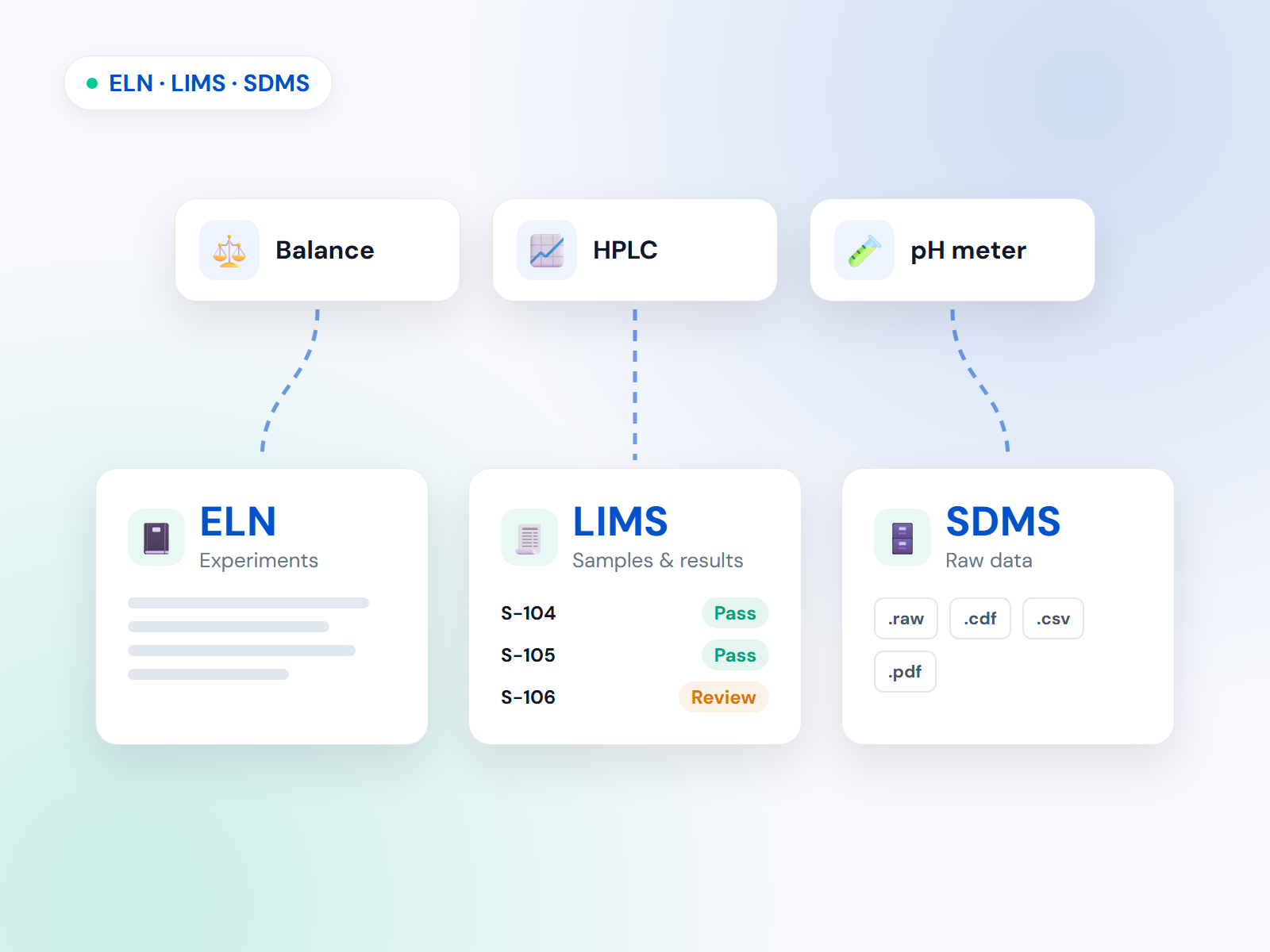
Related systems often sit beside the LIMS. An electronic lab notebook (ELN) records experiments and research work, and a scientific data management system (SDMS) stores raw instrument data and files. Many labs run more than one of these, which makes it even more important that instrument data reaches the right system.
What is lab instrumentation?
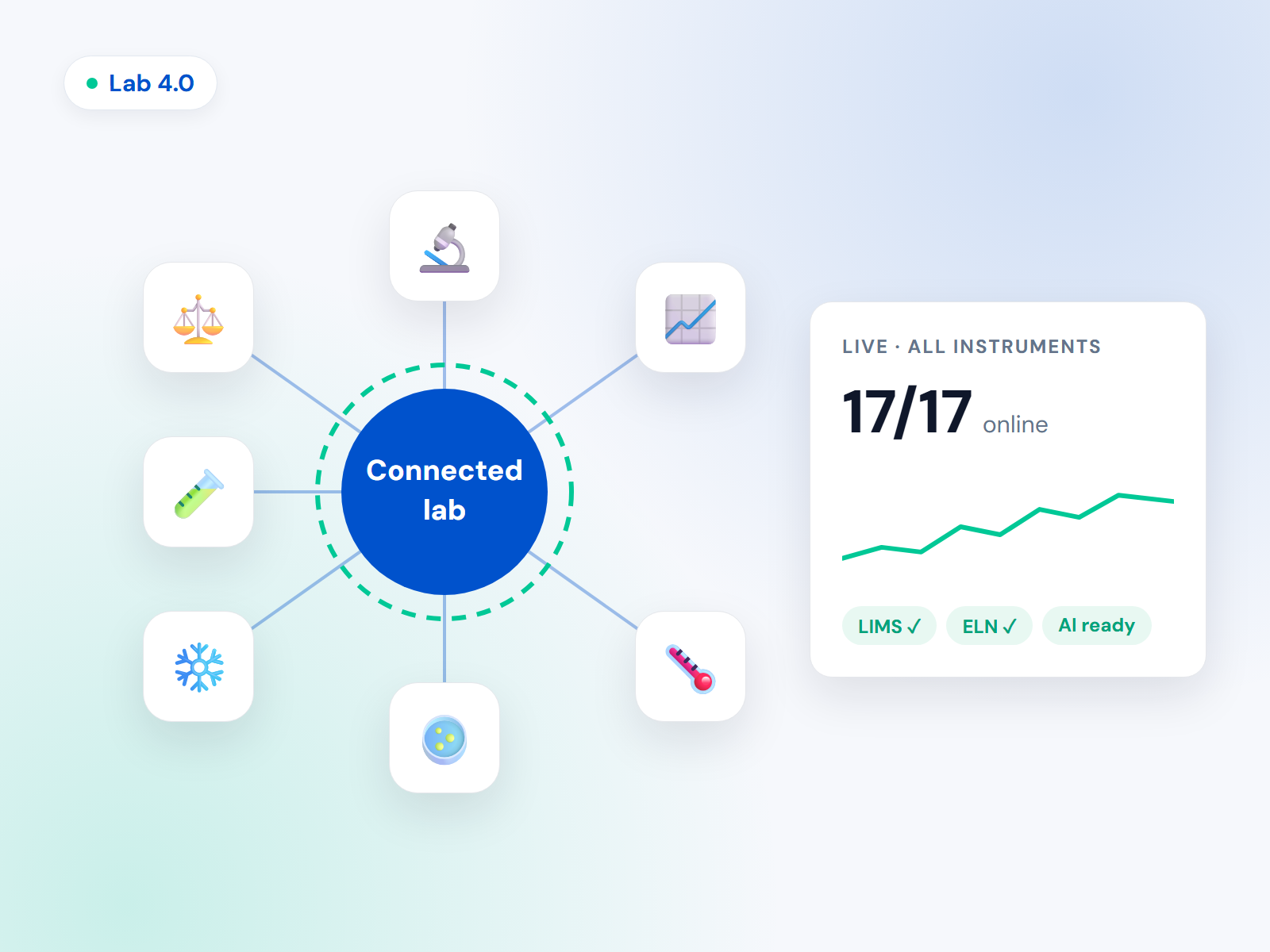
Lab instrumentation is the equipment a lab uses to observe, measure and control: balances, pH meters, titrators, HPLC systems, spectrophotometers, bioreactors, sensors and many more. Each instrument produces data, but they do it in very different ways. Some have modern network interfaces and APIs, while many older instruments only offer a serial RS-232 port, a USB connection, a CSV export or a printout.
How do lab instruments send data to a LIMS?
There are four common ways to get instrument results into a LIMS:
- Manual transcription. An operator reads the value from the display or printout and types it in. It is simple, but slow, and every manual step is a chance for a typing error and a gap in the audit trail.
- File transfer. The instrument or its software exports a file, such as a CSV, which is picked up and parsed. This works, but files can be edited, misplaced or imported twice.
- Point-to-point interfaces. A custom interface links one instrument model to one LIMS. Each new instrument or LIMS change needs another interface.
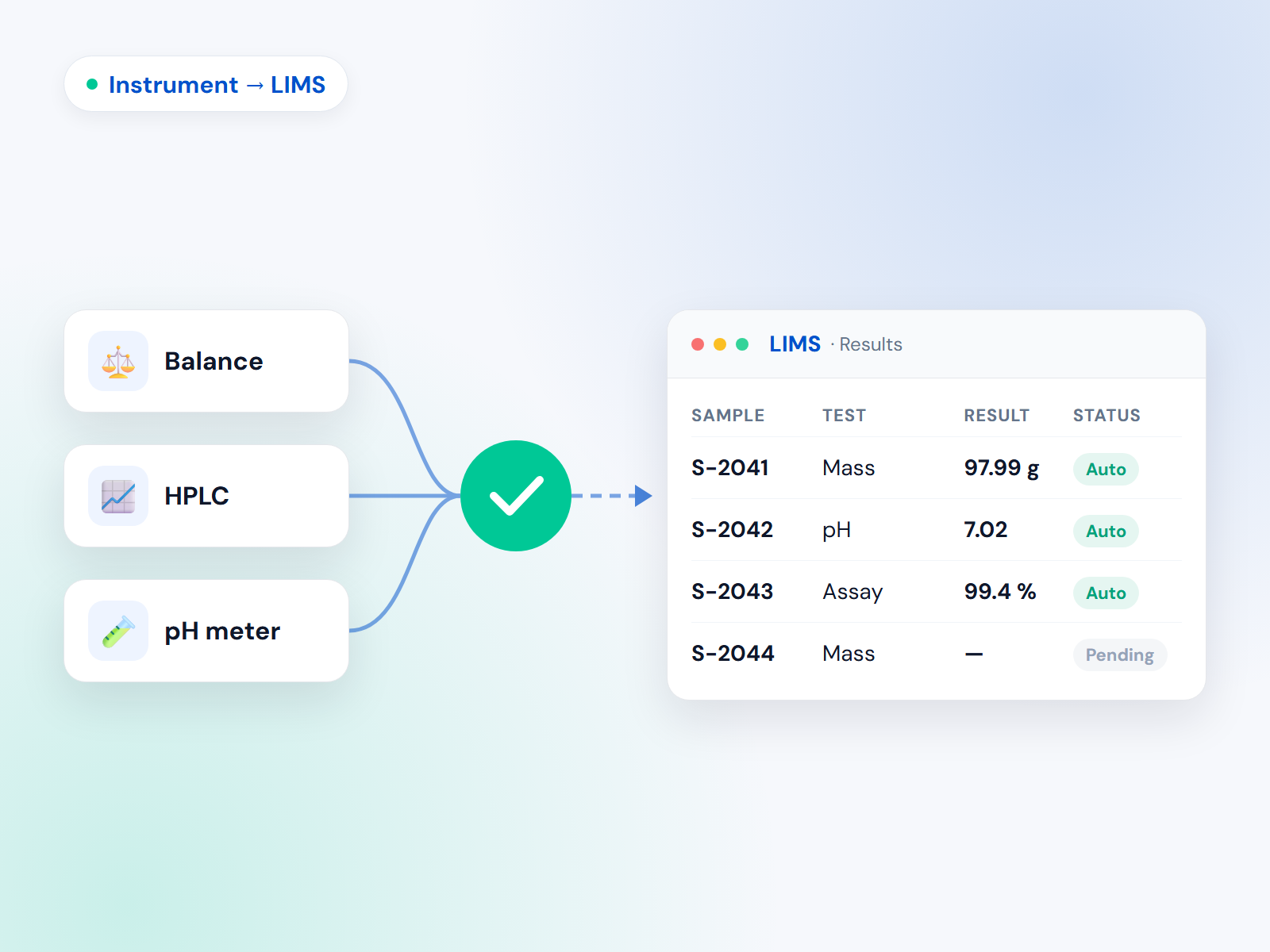
- Instrument connectivity middleware. A middleware layer connects to many instruments, whatever their make or age, captures their data at the source and delivers it to the LIMS, ELN or SDMS in a consistent format.
Why middleware is the practical route
Most labs have a mix of instrument makes and ages, and more than one system that needs the data. Building and maintaining a separate interface for each pair quickly becomes expensive. Middleware solves this once: instruments connect to the middleware, and the middleware connects to your LIMS.
This is what Inniti does for LIMS and ELN integration. Inniti is manufacturer-agnostic, supports more than 3,300 instruments, and handles legacy instruments through RS-232, USB, CSV and even paper-based output. Readings are captured automatically, structured following FAIR principles, and sent to any LIMS, ELN or SDMS with an API. You can read more about the idea in our article on middleware in laboratory digitalization.
Where to start
List the instruments in your lab and how their results reach your LIMS today. The ones that still rely on manual transcription are usually the best place to start. Connecting them removes typing errors, speeds up results and gives you a clean audit trail. From there, laboratory data management and automatic data logging follow naturally.
Want to see how your instruments would connect to your LIMS? Talk to our team.